
TL;DR
Shockwave therapy — formally known as Extracorporeal Shockwave Therapy (ESWT) — is a non-invasive regenerative treatment that uses focused acoustic energy pulses to stimulate healing in damaged joints, tendons, and soft tissues. It promotes new blood vessel formation, collagen remodeling, and pain reduction without needles, surgery, or downtime. ESWT has strong clinical evidence for conditions like plantar fasciitis, tennis elbow, and shoulder tendinopathy, and is increasingly used for broader joint pain management as part of comprehensive regenerative protocols.
Key Takeaways
- Shockwave therapy delivers acoustic energy waves to stimulate the body’s natural repair mechanisms
- It’s completely non-invasive — no needles, no incisions, no anesthesia
- Strong evidence supports its use for chronic tendon conditions and periarticular joint pain
- Most patients need 3–6 sessions spaced one week apart
- Zero downtime — you can return to normal activities immediately after treatment
- ESWT works exceptionally well when combined with other regenerative therapies like PRP and stem cells
What Is Shockwave Therapy (ESWT)?
Extracorporeal Shockwave Therapy (ESWT) is a technology that originated in the 1980s for breaking up kidney stones (lithotripsy). Researchers soon discovered that the same acoustic energy — applied at different intensities — could stimulate tissue healing in musculoskeletal conditions.
Today, ESWT is widely used in sports medicine, orthopedics, and regenerative clinics around the world. At Fountain of Eden Wellness, our shockwave therapy program is an integral part of our approach to joint disease management.
But how does sound energy actually heal damaged tissue? The science is fascinating.
How Does Shockwave Therapy Work?
Shockwave therapy works by delivering high-energy acoustic pulses through the skin and into the targeted tissue. These aren’t ultrasound waves — they’re higher energy, focused pressure waves that create a cascade of biological effects:
1. Neovascularization (New Blood Vessel Growth)
One of the most important mechanisms. Shockwaves stimulate the release of VEGF (Vascular Endothelial Growth Factor) and other angiogenic signals, promoting the growth of new blood vessels in the treatment area. This brings fresh oxygen, nutrients, and healing cells to chronically damaged tissue that may have poor blood supply.
2. Collagen Remodeling
Acoustic energy triggers a controlled micro-trauma response that activates fibroblasts — the cells responsible for collagen production. The new collagen that forms is better organized and more structurally sound than scar tissue, leading to stronger, more functional tissue repair.
3. Calcification Breakdown
In conditions like calcific tendinitis, shockwaves can physically break up calcium deposits within tendons. The body then gradually reabsorbs these fragments, reducing pain and restoring tendon function.
4. Pain Modulation
Shockwaves influence pain through multiple pathways:
- Desensitization of nerve endings — reducing pain signal transmission
- Reduction of substance P — a key neuropeptide involved in pain and inflammation signaling
- Gate control mechanism — overwhelming pain receptors with sensory input to reduce chronic pain perception
- Endorphin release — the body’s natural pain-relieving response to acoustic stimulation
5. Stem Cell Recruitment
Emerging research suggests shockwave energy may help recruit and activate the body’s own resident stem cells in the treatment area, adding a biological regenerative component to the mechanical effects.
What Conditions Does Shockwave Therapy Treat?
ESWT has been studied and used clinically for a wide range of musculoskeletal conditions. Here’s a breakdown of where the evidence is strongest:
Conditions with Strong Evidence
| Condition | Location | How ESWT Helps |
|---|---|---|
| Plantar fasciitis | Foot/heel | Breaks up scar tissue, promotes fascia healing, reduces chronic heel pain |
| Tennis elbow (lateral epicondylitis) | Elbow | Stimulates tendon repair, resolves chronic inflammation |
| Calcific shoulder tendinitis | Shoulder | Dissolves calcium deposits, restores range of motion |
| Achilles tendinopathy | Ankle | Promotes collagen remodeling and blood flow to the tendon |
| Patellar tendinopathy (jumper’s knee) | Knee | Accelerates tendon healing and pain relief |
| Greater trochanteric pain syndrome | Hip | Reduces bursitis-related inflammation and tendon pain |
Conditions with Growing Evidence
- Knee osteoarthritis — periarticular pain reduction and improved function
- Shoulder impingement — reducing inflammation and restoring mobility
- Myofascial trigger points — releasing chronic muscle tension and referred pain
- Non-union bone fractures — stimulating bone healing in fractures that won’t heal on their own
- Hip joint pain — supporting recovery from labral injuries and early arthritis
What Does a Shockwave Therapy Session Feel Like?
Understanding what to expect can help ease any apprehension. Here’s a step-by-step walkthrough of a typical session at Fountain of Eden Wellness:
Before Your Session
- Assessment: Dr. West-Harvey identifies the precise treatment area using physical examination and imaging
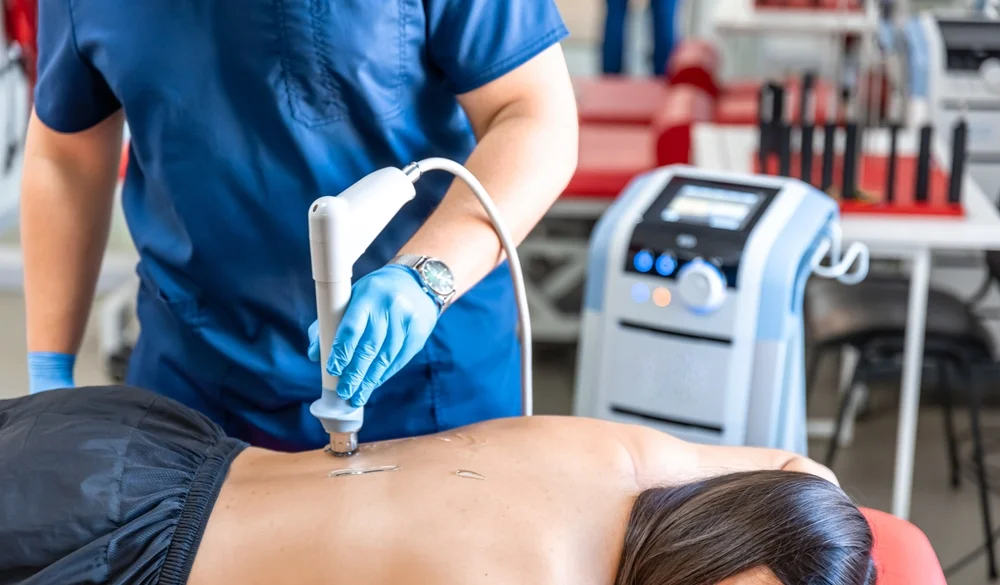
- Preparation: The treatment area is marked, and a conductive gel is applied to the skin (similar to an ultrasound)
- No anesthesia required: Most patients tolerate the treatment well without any numbing
During the Session
- The shockwave applicator is placed against your skin at the treatment site
- You’ll feel rapid tapping or pulsing sensations — some patients describe it as firm, rhythmic pressure
- Intensity is adjustable — we start at a comfortable level and gradually increase based on your tolerance
- Sessions typically last 15–20 minutes depending on the area being treated
- You’ll receive approximately 2,000–3,000 shockwave impulses per session
Pain Level
- Most patients rate the discomfort as 3–5 out of 10 during treatment
- Some areas (like the heel for plantar fasciitis) can be more sensitive initially
- The discomfort is temporary and subsides quickly after the session ends
- Many patients report that the intensity becomes more tolerable as the treatment progresses and in subsequent sessions
After Your Session
- No downtime — you can walk out and resume normal activities immediately
- Some patients experience mild redness, warmth, or slight soreness in the treatment area for 24–48 hours
- Avoid anti-inflammatory medications (NSAIDs) for 48 hours after treatment, as inflammation is part of the healing process
- Ice can be used for comfort if needed
How Many Sessions Do You Need?
The number of sessions depends on your specific condition, its severity, and how your body responds:
| Condition | Typical Sessions | Frequency |
|---|---|---|
| Plantar fasciitis | 3–5 sessions | Weekly |
| Tennis elbow | 3–5 sessions | Weekly |
| Calcific tendinitis | 3–6 sessions | Weekly |
| Achilles tendinopathy | 4–6 sessions | Weekly |
| Knee pain / OA support | 4–6 sessions | Weekly |
| Chronic muscle trigger points | 3–4 sessions | Weekly or biweekly |
Most patients begin to notice improvement after 2–3 sessions, with maximum benefit developing over the following weeks as tissue remodeling continues. The healing effects of shockwave therapy continue to work long after the last session — collagen remodeling and blood vessel growth progress for 8–12 weeks post-treatment.
The Science Behind ESWT: Evidence Overview
Shockwave therapy has one of the strongest evidence bases among regenerative treatments:
- Plantar fasciitis: Multiple randomized controlled trials (RCTs) and systematic reviews confirm ESWT as an effective treatment, with success rates of 60–80% in chronic cases that failed conservative management
- Tennis elbow: RCTs demonstrate significant improvement in pain and grip strength compared to placebo
- Calcific shoulder tendinitis: High-quality evidence shows ESWT can achieve complete or partial calcium resorption in 70–90% of patients
- General tendinopathies: A body of literature supports ESWT as a first-line or second-line treatment for chronic tendon conditions across multiple anatomic sites
Professional medical organizations and sports medicine bodies in Europe and North America have increasingly recognized ESWT as a legitimate, evidence-based treatment modality.
Combining Shockwave Therapy with Other Regenerative Treatments
One of the most exciting aspects of shockwave therapy is how well it synergizes with injection-based regenerative treatments. At Fountain of Eden, we often incorporate ESWT into comprehensive protocols:
Shockwave + PRP Therapy
Shockwave pre-treatment can increase blood flow and tissue permeability in the treatment area before a PRP injection. This may enhance the distribution and effectiveness of the growth factors delivered by PRP.
Shockwave + Stem Cell Therapy
By promoting neovascularization and breaking up scar tissue, ESWT may prepare a healthier tissue environment for stem cell therapy. The improved blood supply and reduced fibrosis can support better stem cell survival and activity.
The Joint Restoration Package
For patients with significant joint disease, our Joint Restoration Package may combine shockwave therapy with injection-based treatments for a comprehensive, multi-mechanism approach to joint healing.
Shockwave + Peptide Therapy
ESWT can complement peptide protocols by improving local circulation and creating the micro-environment conditions that peptides need to exert their tissue-healing effects.
Who Should NOT Have Shockwave Therapy?
While ESWT is generally very safe, certain patients should avoid treatment or discuss risks carefully:
- Pregnant women — shockwaves should not be applied near the uterus
- Patients on blood thinners — increased risk of bruising (discuss with your physician)
- Active infections in the treatment area
- Malignancy — avoid treating areas with known tumors
- Over growth plates in children and adolescents
- Over implanted devices — pacemakers, nerve stimulators (in the treatment zone)
Frequently Asked Questions
Is shockwave therapy the same as ultrasound therapy?
No. While both use acoustic energy, shockwave therapy delivers significantly higher energy pulses that create mechanical and biological effects ultrasound cannot achieve. Ultrasound is primarily used for imaging and gentle tissue warming; ESWT actively triggers tissue regeneration.
Does shockwave therapy work for arthritis?
ESWT is particularly effective for periarticular conditions — pain in the tendons, ligaments, and soft tissues around the joint. For intra-articular arthritis (inside the joint), it’s often most effective when combined with injection-based therapies like PRP or stem cells.
Can I exercise after shockwave therapy?
Yes, most patients can resume normal activities immediately. However, we recommend avoiding high-impact exercise on the treated area for 24–48 hours to allow the initial healing response to take hold.
How long do the results last?
Many patients experience lasting improvement — studies on plantar fasciitis show benefits persisting for 12+ months. Long-term results are best when ESWT is combined with appropriate exercise, lifestyle modifications, and complementary treatments as needed.
Start Your Journey to Pain-Free Movement
Shockwave therapy offers something rare in the world of joint pain treatment: a completely non-invasive option with real regenerative potential. Whether you’re dealing with a stubborn tendon injury, chronic joint pain, or looking to enhance the results of other regenerative therapies, ESWT may be the missing piece of your treatment plan.
Schedule your consultation today with Dr. Michele West-Harvey at Fountain of Eden Wellness and discover how shockwave therapy can help you move freely again.
Disclaimer: This article is for educational purposes only and does not constitute medical advice. Results from shockwave therapy vary by individual and condition. Consult with a qualified physician to determine if ESWT is appropriate for your specific situation.